19,698 people live in Tribeca, where the median age is 41 and the average individual income is $216,472. Data provided by the U.S. Census Bureau.
Total Population
Median Age
Population Density Population Density This is the number of people per square mile in a neighborhood.
Average individual Income
Tribeca is the rare New York neighborhood that reads as quiet and exclusive at the same time. Belgian block streets, twelve-foot ceilings, and warehouse buildings that were never meant to hold apartments have made it one of the most expensive zip codes in the United States — and one of the hardest to buy into, because the supply simply doesn't grow.
This guide covers the boundaries, the architecture, the sub-neighborhoods, what your money actually buys, and the practical realities of living here. It's written for people making a real decision about where to live, not for visitors.
Tribeca sits in Lower Manhattan, west of Broadway and south of SoHo. Its working boundaries are Canal Street to the north, Chambers Street to the south, Broadway to the east, and the Hudson River to the west along West Street (Route 9A).
That southern line is the one people argue about. Some definitions extend to Vesey Street, which pulls in the northern edge of Battery Park City and buildings like 111 Murray. Others stop firmly at Chambers. For practical real estate purposes, listings south of Chambers are often marketed as Tribeca even when they behave more like Financial District or Battery Park City properties — worth knowing before you tour.
The name is an acronym: Triangle Below Canal. It was coined in the 1970s, and it originally described a genuinely narrow triangle formed where Lispenard, Church, and Canal Streets converge. As the neighborhood grew into an identity, the name got applied to everything around it.
The result is that Tribeca is not a triangle. It's a rough trapezoid, largely on a grid, with a name describing a few blocks at its northeastern corner. New Yorkers stopped caring about the geometry decades ago, but it's the first thing most newcomers notice.
The market era (1812–1960s). Starting in 1812, this was Washington Market — New York's primary wholesale produce hub. Masonry warehouses, textile lofts, and cast-iron commercial buildings filled the area, feeding shipping traffic on the Hudson and freight rail. Every architectural feature you now pay a premium for was originally functional: the wide floor plates held inventory, the high ceilings vented heat, the loading doors took wagons.
The collapse (1966). The wholesale produce market relocated to Hunts Point in the Bronx. Urban renewal cleared large sections of the western market area. What remained were blocks of empty industrial buildings in a neighborhood with no residents and no reason for anyone to walk through it.
The artists (1970s). Priced out of SoHo, artists moved south for the same reasons the produce merchants had originally built here — enormous open floors, natural light, and rents that cost almost nothing. The live-work lofts were illegal. The residents organized anyway, formed community groups, and gave the neighborhood its modern name and identity.
Legalization and luxury (1980s–present). New York's Loft Law brought loft living into legal compliance. Landmark designations in 1991 and 1992 locked in the architectural character before developers could erase it. From there, the same warehouses that once held dry goods were converted into some of the most expensive residential property in the country.
The through-line matters if you're buying here: Tribeca's value comes from buildings that were never designed to be housing, in historic districts that prevent more of them from being built.
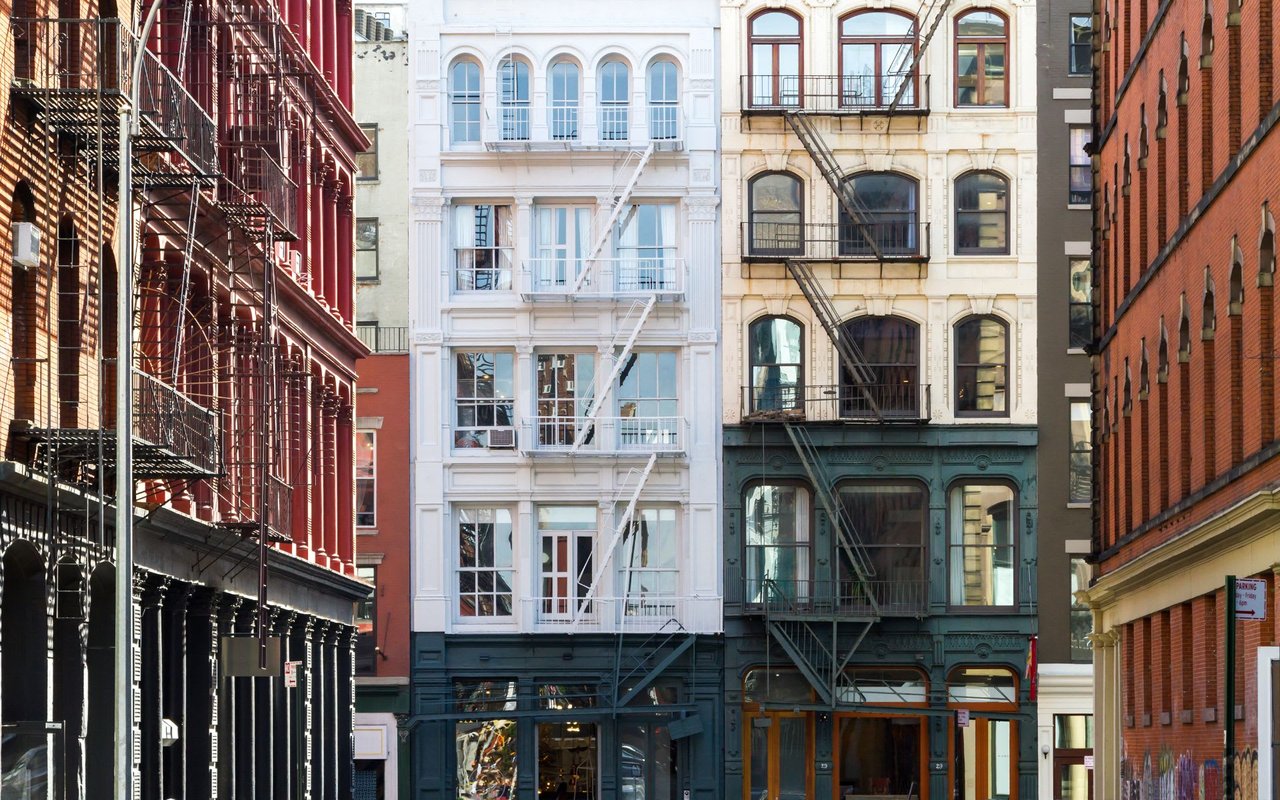
The visual signature of Tribeca is contrast. Nineteenth-century industrial masonry sits directly across the street from twenty-first-century sculptural glass, and the tension between them is the neighborhood's defining aesthetic.
Store-and-loft buildings form the historic core. Built mostly between the 1850s and 1890s, these five-to-eight-story structures carry Italianate, Neo-Grec, and Romanesque Revival facades. The decorative cast-iron ground floors were showrooms for wholesale goods; the massive open floors above were storage. That's why the ceilings are so high and the windows so tall — and why the interiors convert so well into apartments.
Belgian block streets survive on interior blocks like Greenwich, Hubert, and Harrison. People call them cobblestones; they aren't. They're cut granite blocks laid in the nineteenth century to bear heavy freight wagons. They're loud under car tires and they're one of the reasons these blocks feel like a different century.
The four landmarked historic districts were designated in 1991–1992, with an extension in 2002, and they shape what can and can't happen to a building:
The contemporary counterweight exists because landmarking protects interior blocks but leaves the perimeter open. Developers went where they could. 56 Leonard Street — Herzog & de Meuron's 60-story "Jenga building," with its randomly cantilevered floor plates — anchors the eastern skyline. 111 Murray Street rises 792 feet with a flared crown on the southern edge, representing the ground-up ultra-luxury model with full amenity programs.
That split is a genuine fork in the road for buyers. A landmarked loft gives you volume, character, and scarcity. A new tower gives you a gym, a pool, staff, and predictable mechanicals. Very few buildings give you both.
Tribeca is small enough to walk end to end in twenty minutes and varied enough that the four quadrants price and feel differently.
North Tribeca runs from Canal down to roughly Hubert and Beach Streets, between the Hudson and Varick. It's the quietest and the most expensive. Former freight hubs — 443 Greenwich most famously — now hold celebrity-heavy loft conversions with private courtyard drop-offs and subterranean parking. Supply is extremely tight, privacy is the product, and pricing reflects both.
Tribeca West sits below Hubert down to Reade, centered on the Greenwich Street corridor and anchored by Duane Park. This is the quintessential Tribeca most buyers picture: historic dry-goods architecture, tree-lined residential blocks, sidewalk dining, and boutique loft conversions. Demand here is consistently very high.
Tribeca East runs from Church Street to Broadway. It's denser and faster, with larger cast-iron and marble building scale and real traffic spilling in from Chinatown and the Civic Center. It also has the best subway access in the neighborhood, and it's where relative value lives compared to the western blocks.
Tribeca South spans Chambers to Vesey and functions as a transition into the Financial District. It holds the three-tower Independence Plaza complex from the 1970s, modern high-rises like 111 Murray, and the busiest school and office corridors. Median prices run slightly lower here — not because the location is weaker, but because the units are newer and smaller.
Three pockets worth knowing specifically:
The Duane Park pocket surrounds one of the oldest public parks in the city, ringed by nineteenth-century architecture. It's the closest thing Tribeca has to a village square.
The Independence Plaza edge along West Street is a deliberate architectural outlier — three residential towers dropped among low-rise lofts, with larger apartment layouts and a different resident mix.
The Hudson Square edge along Canal Street bleeds into the tech and media office corridor to the north, which brings newer commercial development and daytime density.
Tribeca consistently ranks among Manhattan's most expensive markets, and it gets there through two forces at once: high price per square foot and unusually large floor plates.
Median sale prices run roughly $3.8M to $4.7M, against approximately $1.2M for Manhattan overall. Price per square foot lands around $2,100 to $2,500, compared with a borough-wide average closer to $1,400–$1,600.
Inventory skews heavily toward condominiums — north of 80% of listings — followed by historic co-ops and a small number of townhouses that trade rarely.
Here's what the budget tiers actually get you:
Budget | Typical property | Square footage | What it looks like |
|---|---|---|---|
$1.5M – $2.5M | 1-bed condo or co-op loft | 700 – 1,100 sq ft | Entry point: a one-bedroom in an older conversion or a smaller condo layout, often in Tribeca South |
$3.5M – $5.0M | 2-to-3-bed classic loft | 1,500 – 2,400 sq ft | Full-floor loft with original detail, open living space, high ceilings |
$6.0M – $10.0M+ | Prime loft or high-floor tower | 2,500 – 4,000+ sq ft | North or West Tribeca conversion with keyed elevator entry, or a large layout at 56 Leonard or 100 Barclay |
$15.0M – $40.0M+ | Penthouse or townhouse | 4,500 – 9,000+ sq ft | Multi-level penthouse with private outdoor space, or a restored historic townhouse |
The honest read on that entry tier: at $1.5M–$2.5M you are buying Tribeca's address and location, not its signature apartment. The lofts people move here for begin in the mid-three-millions.
Ownership structure changes the math. Loft co-ops, common in 1970s and 1980s conversions, come with board approval, restrictive sublet rules, and real financial scrutiny — and often a meaningfully lower price per square foot than comparable condos. Condominiums dominate the modern stock, allow flexible subletting, finance more easily, and draw non-resident and investor buyers. If you're buying a pied-à-terre or expect to rent the unit out, the co-op route usually closes off.
Classic loft layouts behave differently than standard apartments. Expect deep rectangular floor plans with windows concentrated at the front and back walls. Interior rooms — dens, home offices, second and third bedrooms — frequently rely on borrowed light rather than their own windows. Ceiling heights from 11 to 16-plus feet mean you're buying volume as much as square footage, and a 1,800-square-foot loft can feel considerably larger than a 1,800-square-foot prewar apartment. Exposed brick, cast-iron columns, timber beams, original loading doors, and keyed elevator access come with the territory.
Due diligence here is specific to conversions. Four things to push on:
Certificate of Occupancy. Confirm the building legally transitioned from commercial or manufacturing use to residential, and check compliance with New York's Loft Law (Article 7-C). This is the single most important document in a conversion purchase.
Mechanical and structural condition. Cast-iron and masonry buildings require ongoing maintenance. Look hard at facade elements, roof membranes, and how heating and HVAC were retrofitted — conversions often handle these building by building, or even unit by unit.
Acoustics. Wood-beam industrial construction transmits impact noise. Many buildings need subfloor soundproofing retrofits, and whether yours has them is a livability question, not a cosmetic one.
Landmark rules. Inside the historic districts, the Landmarks Preservation Commission reviews exterior changes — window replacements, rooftop additions, facade work. If your plan involves altering anything visible from the street, factor in that approval timeline before you close.
Tribeca's rental market doesn't work like most of Manhattan's. There is very little standard high-density rental stock. Inventory concentrates in spacious high-end units — luxury doorman towers and converted boutique lofts — which pushes entry rents well above the borough norm.
Typical price bands:
Three groups do most of the renting here.
Corporate executives and relocations on one-to-three-year assignments who need turnkey luxury space without a capital commitment.
Test-drive buyers — high-net-worth families moving down from the Upper East Side or in from another city, living in the neighborhood for a year before committing several million dollars to it. This is a genuinely smart strategy in Tribeca, where the difference between a North Tribeca block and a Tribeca East block is something you feel rather than read about.
High-profile individuals who need specific building features — keyed elevators, private garages, interior courtyard drop-offs like the one at 443 Greenwich — and want flexibility rather than ownership.
Tribeca's reputation as a family neighborhood surprises people who know its industrial and artist history. But the combination of strong public schools, unusually large apartments, and low traffic density has made it one of Manhattan's premier places to raise children.
Public options start with P.S. 234, the Independence School — one of the most sought-after public elementary schools in New York City, known for its progressive curriculum, active parent community, and red-brick campus on Greenwich Street. Zoning to 234 measurably affects apartment values on nearby blocks, and it's worth verifying the zone for any specific address rather than assuming.
P.S. 150, the Tribeca School, offers a much smaller alternative with tight class sizes. For older students, I.S. 289 sits just south in Battery Park City, and Stuyvesant High School — one of the city's specialized public high schools — stands directly on Tribeca's western edge.
Independent and private options include Washington Market School, a well-regarded Montessori-influenced early childhood program, and Léman Manhattan Preparatory School just to the south. Lower Manhattan's transit density also makes uptown and Brooklyn independent schools commutable, with several running bus service from the area.
Why families choose it despite the price. Three reasons, in order of how often I hear them:
Square footage. Converted lofts deliver three-to-five-bedroom layouts with deep storage and flexible open space that barely exist elsewhere in Downtown Manhattan.
Quiet. Low-rise historic districts and limited through-traffic keep the interior blocks calmer than Midtown or the Financial District.
Outdoor access. Hudson River Park, Washington Market Park, and Duane Park cover the daily needs of a family with young children without requiring a subway ride.
For a neighborhood built for freight, Tribeca has remarkable access to open space — largely because it has a river on one side.
Washington Market Park is the neighborhood's social center. A large children's playground, a community garden, a gazebo, and a manicured central lawn make it the default meeting point for local families, especially after school.
Duane Park is the counterpoint: a small triangular pocket park dating to the late 1790s, generally credited as the first piece of land the City of New York acquired specifically for public use. It's bench-lined, ringed by nineteenth-century architecture, and almost always quiet.
Pier 25 and Pier 26, in the Hudson River Park corridor, do the heavy lifting for recreation. Pier 25 holds an 18-hole mini-golf course, sand volleyball courts, a large maritime-themed playground, splash pads, and historic vessel moorings. Pier 26 is the ecological counterpart, with a tide deck habitat, native coastal plantings, a sports lawn, and lounge areas over the water.
Rockefeller Park, along the northern edge of Battery Park City just below Tribeca South, adds expansive lawns, outdoor sculpture, and riverfront walking paths.
Taken together, that's a stretch of waterfront most Manhattan neighborhoods would trade a great deal for — and it's the amenity residents here reference most often when explaining why they stayed.
Tribeca's food scene is defined by longevity as much as by trend. Restaurants here tend to survive for decades, which is unusual in Manhattan and tells you something about the neighborhood's resident base.
The Odeon, opened in 1980 on West Broadway, is the origin point. It drew Warhol and Basquiat when the surrounding blocks were still mostly empty, and it remains a working neighborhood institution for French-American bistro food and martinis. It's not nostalgia — people still eat there on Tuesdays.
Current destinations include Frenchette, a modern French brasserie that has become one of the most talked-about restaurants downtown, and Locanda Verde in the Greenwich Hotel. Bubby's handles the family brunch and comfort-food side, and has done so long enough to count as an institution itself.
Nightlife runs deliberately low-key. Unlike SoHo or the Lower East Side, Tribeca's evenings center on hotel lounges — the Drawing Room at the Greenwich Hotel among them — quiet wine bars, and subterranean cocktail rooms. There is essentially no club scene, which is a feature for the people who live here and a drawback for those who don't.
Retail is more practical than the neighborhood's image suggests. Greenwich Street functions as the commercial spine, with a large Whole Foods Market and a multi-level Target handling groceries and household needs — a real convenience in a part of Manhattan where full-size supermarkets are scarce.
Boutique retail and galleries fill the side streets, particularly Franklin, White, and Walker, where high-end apparel, independent design studios, and contemporary art spaces preserve a gallery-driven streetscape rather than a chain-store one.
Tribeca's art scene started in lofts and has come back around to them. Over the past decade, the neighborhood has quietly displaced Chelsea as Lower Manhattan's primary gallery corridor — driven by exactly the same architecture that attracted artists in the 1970s. High-ceilinged ground floors and deep subterranean loft levels give galleries footprints that purpose-built spaces can't match.
The Walker, White, and Franklin Street corridors now hold a dense cluster of blue-chip and premier mid-tier galleries, including Bortolami, Marian Goodman, David Zwirner, Jack Shainman, and P·P·O·W.
Non-commercial spaces keep the scene from tipping entirely toward the market. Artists Space on White Street continues its long-running program, and La Monte Young's Dream House remains one of the most singular experimental sound environments in the city.
Performance venues sit close by. PAC NYC, the Perelman Performing Arts Center at the World Trade Center site, is just across Tribeca's southern boundary and brings international theater, dance, and chamber music within walking distance. The Django, a subterranean jazz club beneath the Roxy Hotel, anchors intimate live music.
The Tribeca Festival takes over every June. Founded in 2002 by Jane Rosenthal and Robert De Niro to help revive Lower Manhattan after September 11, it now runs ten to twelve days and brings red-carpet premieres, panels, and outdoor screenings into neighborhood venues.
Its footprint is distributed rather than concentrated — screenings spill into BMCC Tribeca Performing Arts Center, Spring Studios, Regal Battery Park, and Brookfield Place. For residents, that means two weeks of full restaurants, busier sidewalks, and a genuinely energized neighborhood. Whether that reads as a perk or an inconvenience is personal, but it's predictable, seasonal, and over quickly.
Tribeca's transit position is one of its underrated strengths. It sits between major downtown corridors, which means multiple lines rather than dependence on any one.
West side: The 1 train runs local directly through the core, with stops at Franklin Street and Chambers Street; the 2/3 express stops at Chambers. This is the fastest route to Midtown West and the Upper West Side.
Central: The A/C/E lines are accessible at Canal Street and Chambers Street, connecting to the Eighth Avenue corridor and JFK via the A.
East side: The N/Q/R/W at the Canal Street hub and the 4/5/6 at Brooklyn Bridge–City Hall reach Midtown East, Brooklyn, and Queens.
Regional: The PATH train at the World Trade Center Transportation Hub is a three-to-eight-minute walk from Tribeca South, with direct service to Jersey City, Hoboken, and Newark.
Cycling and running: The Hudson River Greenway runs the full western edge as a grade-separated protected path — arguably the best continuous bike infrastructure in Manhattan.
The car question comes up more often here than in most Manhattan neighborhoods, because Tribeca is one of the few places where the answer isn't automatically no.
Against owning one: Express subways put you in Midtown in 15 to 20 minutes. Daily errands — groceries, restaurants, schools, shopping — sit within a five-to-ten-block radius. And the narrow Belgian block streets bottleneck badly, particularly near Canal Street and the Holland Tunnel approach during rush hour. Congestion pricing has changed the calculus further.
For owning one: Tribeca has an unusual concentration of buildings with private subterranean garages and discreet drop-offs, 443 Greenwich and 56 Leonard among them. And access to Route 9A and the Holland Tunnel is immediate, which makes leaving the city — for New Jersey, upstate, or the East End — dramatically easier than it is from Midtown or most of Brooklyn.
If a weekend house is part of your life, Tribeca is one of the better Manhattan neighborhoods to keep a car in. If it isn't, you'll likely never miss having one.
Tribeca rewards people who know it block by block. The difference between a keyed-elevator loft on Harrison Street and a new-construction two-bedroom south of Chambers isn't a line item on a listing sheet — it's a Certificate of Occupancy, a school zone, a co-op board's sublet policy, and whether the building soundproofed its subfloors during conversion. Those are the details that determine whether an apartment works for your life and holds its value.
Keller Williams NYC is a full-service luxury brokerage and the New York City master franchise of Keller Williams, with over 600 agents working across residential sales, leasing, new development, and commercial. Our agents share knowledge, contacts, and market intelligence in a collaborative structure — which means when you work with one of us on a Tribeca search, you have the experience of the whole brokerage behind it.
Whether you're buying your first loft, trading up to a full-floor residence, listing a property in one of the historic districts, or renting for a year to see how the neighborhood fits, we can help you move with real information rather than guesswork.
There's plenty to do around Tribeca, including shopping, dining, nightlife, parks, and more. Data provided by Walk Score and Yelp.
Explore popular things to do in the area, including Dyer Heights GM, Control Theory Jiu Jitsu, and Vince Trained You.
| Name | Category | Distance | Reviews |
Ratings by
Yelp
|
|---|---|---|---|---|
| Shopping | 0.05 miles | 0 reviews | 0/5 stars | |
| Active | 0.26 miles | 0 reviews | 0/5 stars | |
| Active | 0.29 miles | 0 reviews | 0/5 stars | |
| Active | 0.31 miles | 0 reviews | 0/5 stars | |
| Active | 0.36 miles | 0 reviews | 0/5 stars | |
| Active | 0.37 miles | 0 reviews | 0/5 stars | |
| Active | 0.47 miles | 0 reviews | 0/5 stars | |
| Beauty | 0.34 miles | 1 review | 5/5 stars | |
| Beauty | 0.37 miles | 0 reviews | 0/5 stars | |
|
|
||||
|
|
||||
|
|
||||
|
|
||||
|
|
||||
|
|
Tribeca has 8,819 households, with an average household size of 2. Data provided by the U.S. Census Bureau. Here’s what the people living in Tribeca do for work — and how long it takes them to get there. Data provided by the U.S. Census Bureau. 19,698 people call Tribeca home. The population density is 64,728 and the largest age group is Data provided by the U.S. Census Bureau.
Total Population
Population Density Population Density This is the number of people per square mile in a neighborhood.
Median Age
Men vs Women
Population by Age Group
0-9 Years
10-17 Years
18-24 Years
25-64 Years
65-74 Years
75+ Years
Education Level
Total Households
Average Household Size
Average individual Income
Households with Children
With Children:
Without Children:
Marital Status
Blue vs White Collar Workers
Blue Collar:
White Collar: